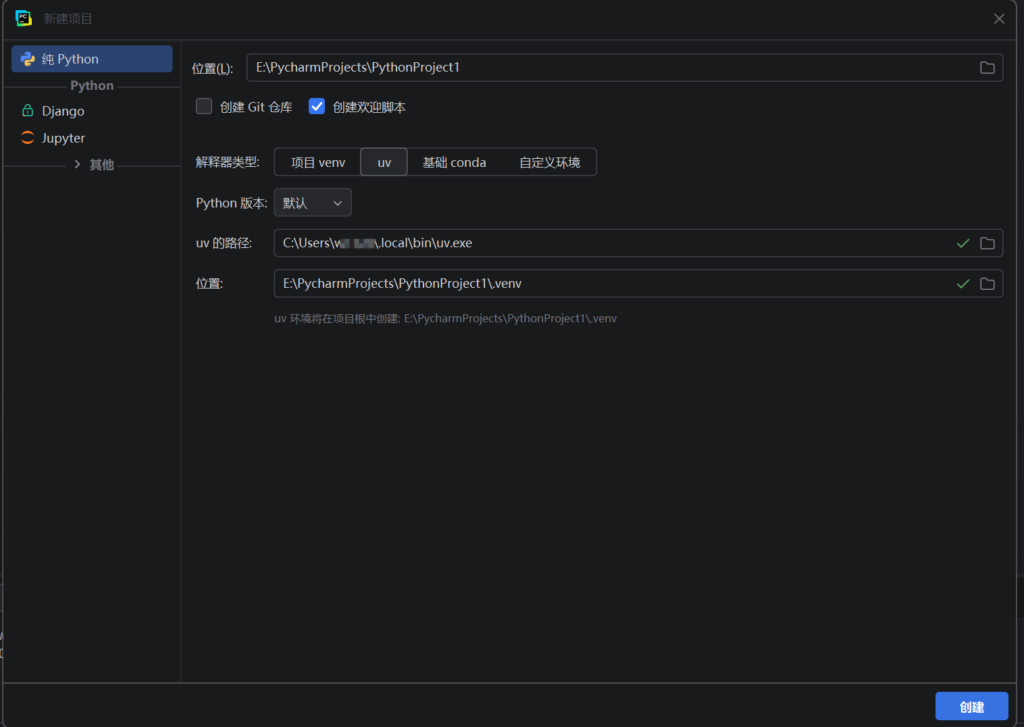
1、pycharm新建项目,纯python项目->解释器类型uv,位置自定义,然后点击创建(python版本不低于3.10)
2、点击终端,依次运行以下指令
(.venv) PS E:\xxx\xx> uv add langgraph
(.venv) PS E:\xxx\xx> uv add langchain
3、复制快速入门中源码
# Step 1: Define tools and model
from langchain.tools import tool
from langchain.chat_models import init_chat_model
model = init_chat_model(
“claude-sonnet-4-6”,
temperature=0
)
# Define tools
@tool
def multiply(a: int, b: int) -> int:
“””Multiply `a` and `b`.
Args:
a: First int
b: Second int
“””
return a * b
@tool
def add(a: int, b: int) -> int:
“””Adds `a` and `b`.
Args:
a: First int
b: Second int
“””
return a + b
@tool
def divide(a: int, b: int) -> float:
“””Divide `a` and `b`.
Args:
a: First int
b: Second int
“””
return a / b
# Augment the LLM with tools
tools = [add, multiply, divide]
tools_by_name = {tool.name: tool for tool in tools}
model_with_tools = model.bind_tools(tools)
# Step 2: Define state
from langchain.messages import AnyMessage
from typing_extensions import TypedDict, Annotated
import operator
class MessagesState(TypedDict):
messages: Annotated[list[AnyMessage], operator.add]
llm_calls: int
# Step 3: Define model node
from langchain.messages import SystemMessage
def llm_call(state: MessagesState):
“””LLM decides whether to call a tool or not”””
return {
“messages”: [
model_with_tools.invoke(
[
SystemMessage(
content=”You are a helpful assistant tasked with performing arithmetic on a set of inputs.”
)
]
+ state[“messages”]
)
],
“llm_calls”: state.get(‘llm_calls’, 0) + 1
}
# Step 4: Define tool node
from langchain.messages import ToolMessage
def tool_node(state: MessagesState):
“””Performs the tool call”””
result = []
for tool_call in state[“messages”][-1].tool_calls:
tool = tools_by_name[tool_call[“name”]]
observation = tool.invoke(tool_call[“args”])
result.append(ToolMessage(content=observation, tool_call_id=tool_call[“id”]))
return {“messages”: result}
# Step 5: Define logic to determine whether to end
from typing import Literal
from langgraph.graph import StateGraph, START, END
# Conditional edge function to route to the tool node or end based upon whether the LLM made a tool call
def should_continue(state: MessagesState) -> Literal[“tool_node”, END]:
“””Decide if we should continue the loop or stop based upon whether the LLM made a tool call”””
messages = state[“messages”]
last_message = messages[-1]
# If the LLM makes a tool call, then perform an action
if last_message.tool_calls:
return “tool_node”
# Otherwise, we stop (reply to the user)
return END
# Step 6: Build agent
# Build workflow
agent_builder = StateGraph(MessagesState)
# Add nodes
agent_builder.add_node(“llm_call”, llm_call)
agent_builder.add_node(“tool_node”, tool_node)
# Add edges to connect nodes
agent_builder.add_edge(START, “llm_call”)
agent_builder.add_conditional_edges(
“llm_call”,
should_continue,
[“tool_node”, END]
)
agent_builder.add_edge(“tool_node”, “llm_call”)
# Compile the agent
agent = agent_builder.compile()
from IPython.display import Image, display
# Show the agent
display(Image(agent.get_graph(xray=True).draw_mermaid_png()))
# Invoke
from langchain.messages import HumanMessage
messages = [HumanMessage(content=”Add 3 and 4.”)]
messages = agent.invoke({“messages”: messages})
for m in messages[“messages”]:
m.pretty_print()
以deepseek V4连接为例
根据编写之日看deepseek说:init_chat_model 对 DeepSeek 的“原生”支持不如 ChatOpenAI 稳定,因此强烈建议直接使用 ChatOpenAI
所以上述代码咱们需要变更一处内容
将
model = init_chat_model(
“claude-sonnet-4-6”,
temperature=0
)
修改为以下内容
from langchain_openai import ChatOpenAI
model = ChatOpenAI(
model=”deepseek-chat”, #模型根据官方接口文档进行修正
api_key=”sk-…”, # 替换为你的实际 key
base_url=”https://api.deepseek.com”,
temperature=0
)
之后只需要再安装langchain_openai和IPython至项目中即可通过运行main.py,就可以得到以下输出内容:
================================ Human Message =================================
Add 3 and 4.
================================== Ai Message ==================================
Tool Calls:
add (call_00_xxxxxxxxxxx)
Call ID: call_00_xxxxxxxxxxx
Args:
a: 3
b: 4
================================= Tool Message =================================
7
================================== Ai Message ==================================
The sum of 3 and 4 is **7**.